From Gas Works to Market Hall: The story of Leigh Market and its Gas Street home
Leigh Market is set to go through another period of change, but have you ever wondered why it sits on Gas Street? Or where the market was before the current hall and Spinning Gate Centre were built?
My interest in the site started while looking through old maps of Leigh. The gasworks site stood out as a large industrial patch just off Bradshawgate, covering roughly the land where the new market stands, part of the shopping centre and the car park. Once I understood why it's called Gas Street, I knew I should look into it for the 'Layers of Leigh Blog' investigating the history of Leigh Town Centre as new developments happen.
As it turns out, these gas works have played a big part in Leigh's history and offer a thread for looking into how the town has developed. Although this blog shows how the use of the land has changed, it also reflects a space that has been used for local benefit from a municipal gas works to local market that influenced the unification of Leigh’s townships.
Gas Street's industrial past
According to A History of Leigh by John Lunn, the Leigh Gas Company was founded in 1834. The National Gas Museum notes that most cities and large towns had gasworks by the 1820s. For a growing town like Leigh, establishing a gas company in the 1830s seems significant.
The gas produced here was known as ‘town gas’. Coal was heated in enclosed retorts, releasing gas which could then be cleaned, stored and sent through mains. Coal was certainly not in short supply around Leigh! The collieries and mills created both the fuel and the demand for a local energy supply. Its location next to the old train line also meant that materials could be transported easily, before road travel replaced rail for moving freight.
Historic England’s survey shows seven gas works in Leigh. One was the public works on Gas Street, while the other six were connected with mills and factories, at a time when these businesses would have had to secure their own supply of energy.
Light and power are things we take for granted today, but a town gasworks was a big deal. Gas lighting allowed streets, shops and workplaces to remain active after dark. It later provided fuel for cooking and heating too. Although it might seem odd that this industrial works was in the centre of town, this was at a time when people lived near mills and factories. The central location would have also allowed for the efficient supply of gas to the growing town.
Mapping the market's future home
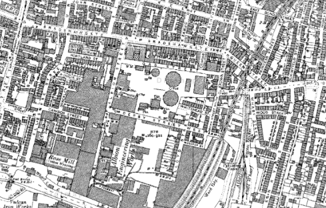 Map of Leigh from the 1920s.
Source: National Library of Scotland.
The map of Leigh in the 1920s gives a good idea of just how large the works were. The gas and electricity works were bounded by Gas Street to the north, Brown Street to the east, Derby Street to the south, and Albion Street to the west. Spinning Jenny Way did not yet exist, and the area looked completely different from the retail and transport hub we know today. Large circular gas holders are easy to spot on the map, with other stores and buildings visible on the site.
It is strange to think that shoppers walking through this part of Leigh are crossing a former industrial site. Are there any residents who remember the last structures standing, or who heard stories about the works from parents and grandparents?
The Leigh Gas Question
There's a saying that history has a habit of rhyming, and that's what I thought of when reading about the 19th century debate over whether the gasworks should be owned by investors or the local government.
A Leigh Chronicle and Weekly Advertiser article from 1861 reported a proposal for an Atherton, Bedford, Leigh and Tyldesley District Gas and Water Works, estimated at £60,000 (equivalent to over £6,000,000 today based on inflation).
 Aerial photo of Leigh Town Centre, Gas works visible towards bottom left.
Source: Wigan and Leigh Archives.
A proposed Act of Parliament dated 28th June 1861 authorised a company to construct a gasworks and supply Atherton, Bedford, Pennington, Tyldesley-cum-Shakerley, Westleigh and other places in Lancashire. From what I can tell, this cost was for purchasing the existing gas works and upgrading it to better supply the towns.
In 1873 the three local boards of Pennington, Westleigh and Bedford each had to support the purchase before a Bill could go to Parliament. At a Pennington Board meeting in September, a member named Hayes reportedly pointed to Manchester, where profits from publicly owned gas and water works helped to pay for local investments.
But not everyone agreed. One opposing view was that there was plenty of private capital available to improve the gas supply and develop a water supply. If Leigh did not do it itself, perhaps larger places such as Liverpool or Bolton could extent their works to cover Leigh.
It seems that the investment in gas, water, and sewerage led to the creation of the Leigh Board and ultimately the town becoming one area. Separate local board meetings in each of the townships were not just debates on the gas works but also a debate on unifying the towns.
The debates led to some scenes that reminded me of exchanges you might see beneath a Facebook post or YouTube video today! In a series of letters to the editor on the Leigh Gas Question, quite the debate had started between two contributors. By the fourth contribution from 'Justitia', he was calling his opponent a 'dolt' and added: 'Existence would be a shorn of half its enjoyments if all the fools were driven out of the world. He also said 'They like all other elements of human nature, have a side which is very hard to look upon otherwise than with the same smile we grant to the playful tricks of a chimpanzee'.
This anonymous contributor was in favour of the local board owning the gas works, complaining about the morality of private owners and adding 'the works ought to belong to the townships through which the Company's mains now run'.
The Municipal Gas works
For almost the next 80 years, gas production continued with output being expanded and production levels increased, production was impacted by wartime rationing. Expansions were made to the facility in 1911, 1915, 1930, 1934 and 1944. The volume of gas production greatly increased over this period from 109,772,000 cubic foot to 485,620,000 shortly before nationalisation in 1948.
Production then ended in 1953, as Leigh joined the North-West Gas Board. Town gas across the country was phased out in the 1960s and 1970s, as North Sea Gas replaced it. I've not been able to find what the site was used for between the closure of the gas works and the construction of the market. Do you remember the old gas works when they were in use or sitting idle?
Leigh Market
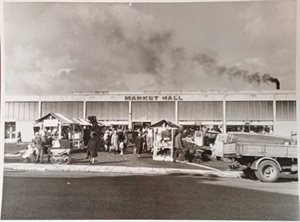 Leigh Market in the 1970s
Source: Wigan and Leigh Archives.
Leigh Market has its own long history. In 1888, the Leigh Local Board purchased the right to hold a market from Lord Lilford for £1,500. The rights had passed through the Warrington and Atherton families before reaching the Lilford Family. Bringing them into local ownership made the market an important civic asset as well as a place to trade.
For much of the twentieth century, the market was around Civic Square. It later moved to a purpose built site north of St Mary’s Church, on land now occupied by ASDA. The move from Civic Square was completed by 1971. Did you shop or work at either of these earlier markets?
There is also an interesting document in the archives from the Hong Kong Urban Council and Urban Services Department, thanking the council for sharing information about Leigh’s market. I can't be sure about the exact connection, but at the time Hong Kong was modernising its markets and as a crown colony it would make sense for them to gather ideas from new market developments across the UK.
The market comes to Gas Street
By the 1980s, the former gasworks land was chosen for a major regeneration scheme. Spinning Gate, the bus station and a new market hall would turn an under used industrial site into a retail and transport hub.
Interest from traders was high, with about 250 applications for 150 stalls. Johnny Lee, chairman of Leigh Market Traders Association, had been closely involved in the process. He admitted that it had not always been straightforward, but described Spinning Gate as ‘without doubt the most prestigious development in Leigh in the past 100 years’ and said that he felt privileged to be part of it.
Geoff Fairclough also looked forward to the move. His grandmother had started the Whittle’s stall around ninety years earlier (around 130 years from today), so his family already had deep roots in the market. He said: ‘With this move Leigh will be getting its heart back and you can’t get any better than that.’
The new market opened on 4 December 1989, with television presenter Timmy Mallett joining the celebrations. Were you there on opening day? Perhaps you remember your favourite stall, worked in the market or moved there from the St Mary’s site.
Another layer for Leigh
The market is now entering another period of change, with an active project to revitalise the market hall on Gas Street.
Do you remember the gasworks site, the old market near St Mary’s or the opening of the present market in 1989? Did someone in your family work at the gas or electricity works? We would love to hear your stories and see any photographs you may have. They could help fill the remaining gaps, and add another voice to the history of Gas Street.
Bibliography
- Thomas, Russell. The Manufactured Gas Industry Volume 3. Historic England
- National Library of Scotland (external link). Map Image
- Wigan and Leigh Archives
- PC2016.749 - Aerial view of the town centre. 1937
- 942.736 ‘Borough of Leigh Jubilee, 1899-1949: Fifty Years of Municipal Progress’
- MB/Lei/M1 - File on Leigh Market Hall (1968-1972)
- Lunn, J. 1959 .Leigh: The Historical Past of a Lancashire Borough. The Co-Operative Press Limited. Manchester
- Leigh Journal Thursday 4th December 1989
- British Newspaper Archive (external link)
- Leigh Chronicle and Weekly District Advertiser - Saturday 19th January 1861
- Leigh Chronicle and Weekly District Advertiser - Saturday 23rd January 1873
- Leigh Chronicle and Weekly District Advertiser - Saturday 27th September 1873
- Leigh Journal - Friday 18th December 1953
Posted on Thursday 20th August 2026