Leigh's Lilford Hotel - well-ordered, friendly and first class!
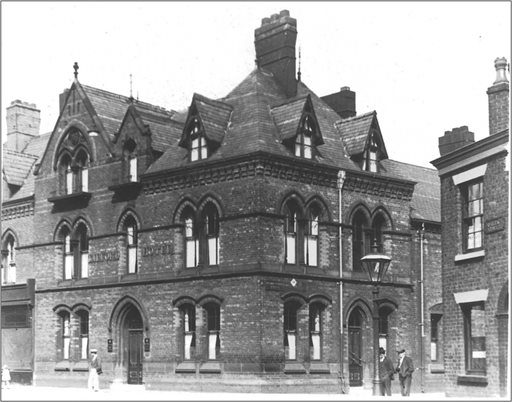
The Lilford Hotel, situated on the corner of Bradshawgate and Brown Street. Source: Archives: Wigan and Leigh (PC2012.13212).
123-127 Bradshawgate, also known as the former Lilford Hotel, is one of the projects which is being funded through the Leigh Town Centre Building Grant Scheme. This is one of Leigh’s most architecturally significant buildings, and it has an interesting social history too!
The Lilford Hotel opens
The Lilford Hotel was built in 1876 and cost £3,000. It was designed by local architect J C Prestwich in the Gothic Revival architectural style. Characteristics of this style include the simple pointed arched windows with stone shafts and stiff leaf capitals.
A newspaper advert in the Leigh Journal and Times, on Saturday 14th July 1877, reported ‘The Lilford Hotel, Bradshawgate, Leigh, is now open’. George Rawding was the proprietor and clearly wanted to make a good impression as the newspaper advert declared ‘the proprietor hopes by supplying a good article at a moderate price to merit the support of the public of Leigh’.
However, in 1877, the original landlord was ejected for ‘licensing irregularities and paying £120 rent per annum’, which was five times the normal rents in those days.
An advert in the Leigh Chronicle and Weekly Digest, on 18th January 1879, reported that ‘the Lilford Hotel… well-ordered, first class, commercial and friendly hotel, is now under entirely new management’. The advert stated that a William Hodgson was the Manager.
Joseph Jackson took over as landlord of the Lilford Hotel between 1880 and 1885 and ‘made the place thrive’. According to the Leigh Town Trail and other sources ‘the Hotel included four cellars, nine ground floor rooms, twelve bedrooms, stabling and a coach house and could feed 70 people but only offered four beds and stabled six horses in 1890. Bed spaces were limited by the large billiards and other reception rooms on the first floor’. I wonder how they got the large billiard tables upstairs?
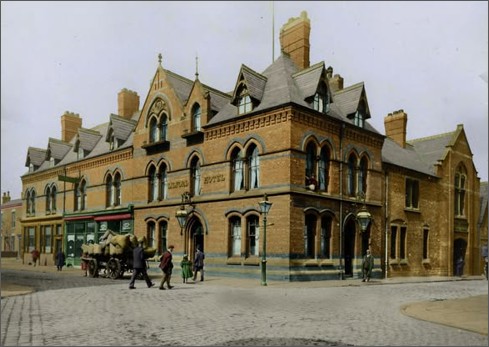 Colourisation of the Lilford Hotel by Jonathan Coombes.
Source: Leigh, Atherton and Tyldesley Heritage Group Facebook.
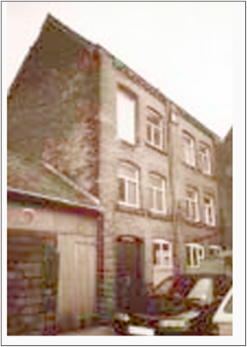 The Lilford Brewery built by Joseph Jackson at the rear of the Lilford Hotel in 1895.
Source: Wigan Council (Leigh Town Centre Trail).
In 1895 Jackson added a 20-barrel brewery to the rear. The Leigh Town Centre Trail describes the brewery building and notes key architectural details such as the blue and red alternating bricks above the windows and doors and the tall third floor doorway, which is known as a taking-in door. The taking-in door would allow the raw materials used in the brewery to be lifted in using a hoist. Although no evidence of the crane arm that would have been over the door remains in the late twentieth century photograph above.
Jackson died on 14th January 1899, and the brewery was put up for sale. According to the Brewery History Society Wiki, it was purchased by George Shaw. However, the Leigh, Atherton and Tyldesley Heritage Group state that ‘BBM and Co bought the complex upon Jackson’s death for £16,150 and £365 for the cottage. They closed down the brewery, but retained the rest’. Does anyone know if George Shaw owned BBM and Co?
Bromilow the Bowler
In 1916, John Bromilow was the proprietor of the Lilford Hotel. John was also president of the Professional Bowlers’ Association and well respected in Leigh. An article in the Manchester Evening News, on Thursday 2nd March 1916, reported that John had joined the army and ‘the licence of the Lilford Hotel was, at Leigh today, transferred from him to Daniel Banks of Widnes’.
I haven’t been able to find who the proprietor was after Daniel Banks, but the pub’s licence expired in 1971. Can anyone remember having a final pint in the pub before it closed?
Unsympathetic alterations
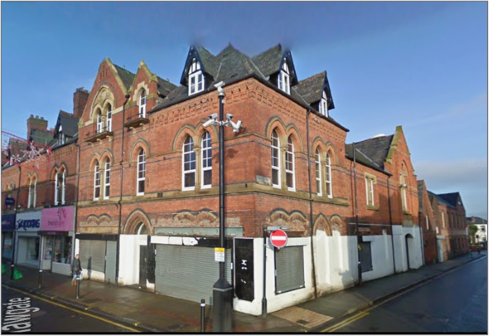 The former Lilford Hotel in December 2009.
Source: Google Maps (Streetview).
Following the pub’s closure, unsympathetic alterations occurred including the removal of the ground floor arched windows in order to widen the window openings to expand the shop window frontage onto the street. The upper floors were converted to apartments. According to the Leigh, Atherton and Tyldesley Heritage Group, it was used as a DIY store and then as a carpet showroom. Does anyone remember buying tools or carpets in the shop? Did they take down internal walls to create larger shop spaces for these uses?
Recent history
In 2014, works to the ground floor shopfronts occurred to bring them back into use and improve their external appearance. This was funded through the ‘Military Bond Scheme Fund’ which targeted ‘empty building refurbishment which the high street banks are unwilling to lend on’.
Although these improvement works occurred, the modern shopfronts with large timber boarding detract from the character of the Leigh Town Centre Conservation Area. However, this building is still recognised as a ‘building of townscape merit’ due to its Gothic Revival architectural style, terracotta detailing and arched window openings on the first floor.
Works to remove the timber cladding and reinstate historic features such as pilasters and fascia boards have commenced on site. The new details will replicate historic shopfronts that can be seen in photos and still exist in some parts of the building. The proposals have been designed by Halsall Lloyd Partnership (HLP), and the appointed contractor is Hayes Joinery Ltd. What a transformation this will bring to one of Leigh’s most significant and prominent buildings!
Interestingly, when removing the timber cladding, a ghost sign was revealed with the letters ‘EWS’. EWS stands for ‘Emergency Water Supplies’ which historically told the local fire brigade where emergency water supplies could be found during bombing raids in the Second World War.
We would love to hear more stories and memories about the former Lilford Hotel and other properties in Leigh. We will be publishing blog posts each month so please complete a submission form on the blog homepage with any memories or interesting information we could include.
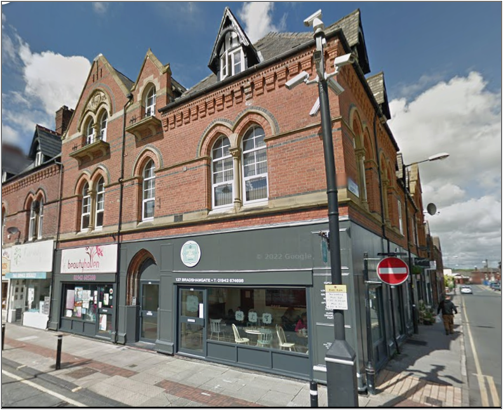 The Lilford Hotel in May 2014, following external improvement works.
Source: Google maps (Streetview).
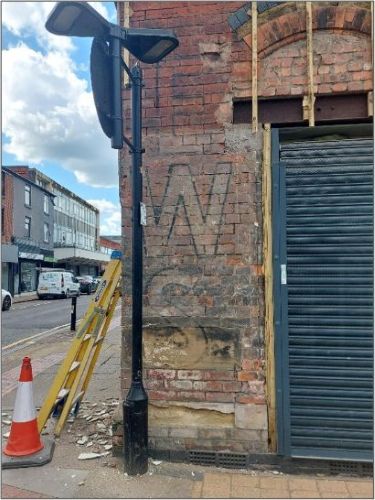 ‘EWS’ or ‘Emergency Water Supplies’ ghost sign which was uncovered as part of the shopfront works.
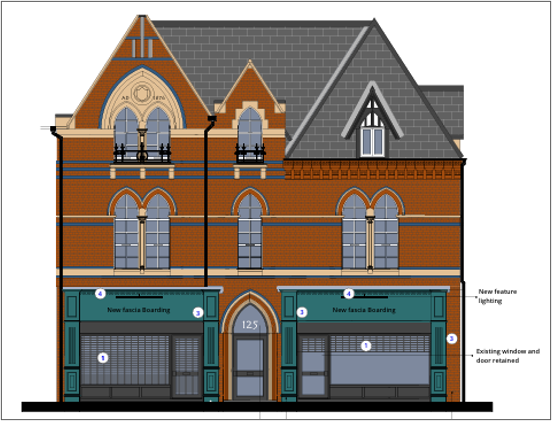 Proposed shopfront improvement works to Bradshawgate elevation.
Source: Halsall Lloyd Partnership (HLP).
Bibliography
- Archives: Wigan and Leigh. Reference PC2012.13212
- Brewery History Society Wiki (external link) - Lilford Hotel, Greater Manchester
- Co-Curate (external link) - EWS: Emergency Water Supply
- Google Streetview (external link)
- Halsall Lloyd Partnership. Heritage Statement 123-127 Bradshawgate, Leigh
- Leigh, Atherton and Tyldesley Heritage Group. Belting Buildings of Leyth, Facebook (external link)
- Leigh Journal
- The British Newspaper Archive (external link)
- About John Bromilow, Sporting Chronicle - Saturday 27th May 1916
- Billiards, Manchester Evening News - Thursday 2nd March 1916
- The Lilford Hotel Bradshawgate and Brown Street, Leigh, Leigh Chronicle and Weekly Digest - 18th January 1879
- The Lilford Hotel, Bradshawgate, Leigh, Is Now Open’, Leigh Journal and Times - Saturday 14 July 1877
- Wigan and Leigh Buildings (external link) - Lilford Hotel, Buildings of Interest
- Wigan Council
- Leigh Town Centre Conservation Area Appraisal
- Leigh Town Centre Trail
Posted on Wednesday 10th June 2026