A Candle, a Curtain, and a Coal Miner at 64 Gerard Street
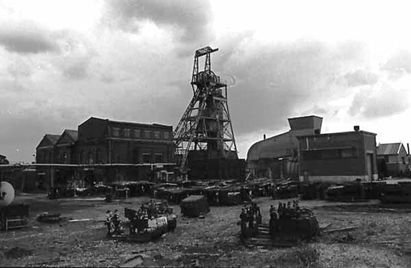
Photo of Golborne Colliery from the Northern Mining Research Society.
When I set out to write a blog post about the building at 64 Gerard Street, I searched in the British Newspaper Archive I only found one article, from the Wigan Examiner dated Saturday the 2nd of May 1896. It reported a fire at a chip potato shop, which was located on the ground floor of the building. The fire was in the apartment above and started when a candle accidentally set a curtain on fire. A police officer named Constable Singleton ran inside and helped Mrs Rampling’s sister (wife of James Rampling and occupier/shop owner) throw the burning curtain into the street. A passing miner, Michael Webb from Bryn, then stamped out the fire.
The story gives us a glimpse into life in Ashton and the transformation that it experienced in the industrial era. Two inventions, Paraffin and a mechanical candle maker (invented in Manchester), made candles cheaper, more reliable and more accessible to ordinary people.
Before electric lighting was common, people relied more on natural light. Due to this, buildings were often designed to let in more daylight. If you’re interested in how 64 Gerard Street was designed and the history of the building’s occupants, visit the historic development of 64 Gerard Street.
Candles and coal
The miner in the story probably worked in one of Ashton’s many local coal mines. These mines played a big role in the town’s growth. Before oil drilling became common, oil was produced by extracting it from shale and coal. A Scottish chemist named James "Paraffin" Young became famous (and rich) for doing this. He helped develop paraffin, which was used in candles, machinery, textiles, and cosmetics among other things.
Young has a local connection; he worked at a chemical plant in Newton-le-Willows when he was 28. Later, he became known as a father of the petrochemical industry for his work in Derbyshire and Scotland. Young’s company made Scotland the world's leading producer of oil for a brief period of the 1850s. It was ultimately absorbed into BP after free flowing oil made the shale distillation oil uncompetitive in price.
Lighting in mines
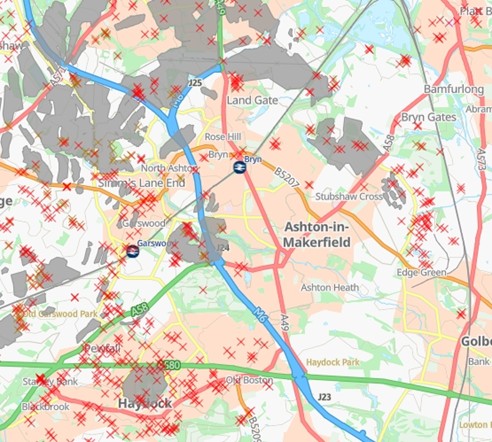 Mining Remediation Authority Mapping around Ashton-in-Makerfield.
Red crosses indicate mine entries and the grey areas show past Surface mining.
Miners have always needed light underground. In Ashton’s mines, candles were often used, but they were dangerous. Many local mining accidents were caused by gas explosions, sometimes triggered by candles. Even after safety lamps and electric lights were invented, candles were still used because they were cheap and easy to obtain. Many workers continued to use them, simply because they were used to candles as a tool.
While more common in earlier disasters, candles played a role even around the time of the fire at 64 Gerard Street. Newspaper reports of an inquiry into an underground explosion at the Old Boston Colliery, in Haydock, on the 29th of June 1900, which killed 8 men, showed a debate as to whether the ignition of gases was caused by candles or sparks from tools striking the earth. The team of 10 sinkers were using a combination of electric and candle lighting when a pocket of gas ignited. Of the miners who lost their lives, Patrick Flaherty and John Fitzpatrick were residents of Ashton-in-Makerfield. The company was sued, and paid out compensation to relatives of three of the deceased as the company was found to have not provided enough electric lighting and neither provided nor insisted on the use of safety lamps which indicate the presence of gas.
Garswood Colliery was known for testing safety innovations, to avoid the sort of accident described above. From 1880 onwards, over 200 types of safety lamps were tested on the site. There were also experiments with explosives to figure out how to better avoid igniting gas present in the mine. The coalfield in Lancashire is a bituminous form of coil, which means it is of medium quality and contains other substances such as gases which leaked.
Conclusion
As work begins on site, this blog will start to focus more on the progress of the projects themselves. I hope you enjoyed reading this post, I really enjoyed uncovering the connections between everyday life in Ashton’s industrial past.
We’d love to hear your stories or memories about 64 Gerard Street or other buildings in Ashton. Get in touch with your Ashton building story.
References
Posted on Wednesday 11th March 2026